


Seeing the Unseen: How SWIR Imaging Transforms Modern Sorting Systems
Introduction
Visible light cameras cannot see everything that matters. Ejecting organic versus non-organic material on sorting equipment such as clear plastic from a potato stream or grading peaches by sugar content, identifying different fabrics for clothes recycling (nylon vs wool); conventional systems consistently fall short. Compositional differences, sub-surface defects, and moisture gradients are invisible in the 400–700 nm band that human eyes inhabit.
SWIR imaging (900–1700 nm) reveals material differences based on molecular properties like water, fat and protein content, rather than just surface color. This enables high-contrast sorting, making SWIR the preferred sensor for infrared food inspection, recycling, and industrial quality control.

Water as a Sorting Tool: Contaminant Detection in Food Lines
Water absorbs SWIR radiation strongly at specific wavelengths, creating striking contrast between water-rich materials and dry contaminants. Plastics, glass, stones, and wood all appear distinctly different from organic products when viewed in the SWIR band. This moisture-based sorting technology is SWIR's most commercially proven capability.
SWIR foreign object detection exploits this directly: a translucent polypropylene fragment among pale potato pieces is invisible to a color camera, yet under SWIR illumination it reflects strongly where wet product absorbs, producing bright-dark contrast at line rates up to 40 kHz.
Applications include:
- Foreign object detection: stones, bone fragments, and glass shards in washed produce appear distinctly against products with high moisture content under SWIR.
- Identifying wooden splinters or cardboard in frozen vegetable packs, where SWIR reflectance holds at low temperatures. A typical SWIR‑based sorting setup, combining line‑scan imaging with real‑time air‑jet ejection, is shown in Figure 2.
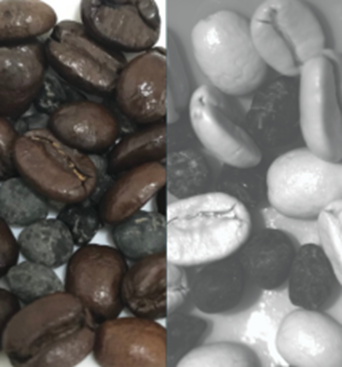
Figure 1. SWIR line-scan image revealing a foreign contaminant in a food stream — invisible to color cameras, clearly detected in the SWIR band.
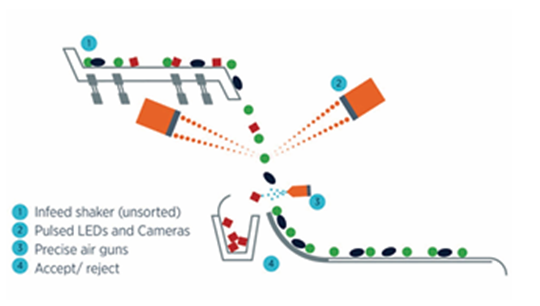
Figure 2: Schematic setup of automated food inspection and sorting application using SWIR cameras.
Beneath the Surface: Internal Defects, Ripeness, and Chemical Fingerprinting
SWIR imaging penetrates below the surface of biological tissue, revealing internal defects like bruising or decay in produce long before they become visible, enabling earlier and more effective inspection than visible or NIR cameras.
In hyperspectral or multispectral modes, SWIR allows rapid, real-time chemical analysis, such as grading fruit maturity by sugar content, mapping fat or moisture in meat, sorting grains by protein, and profiling avocado ripeness, enabling fast, production-scale sorting.
From Food to Industry: Where SWIR Adds Value Across Modern Sorting Systems
While food inspection remains the most established application of SWIR, the same physical principles extend across a wider range of sorting and inspection challenges. Beyond agriculture, SWIR delivers measurable value in recycling, industrial inspection, and packaging integrity.
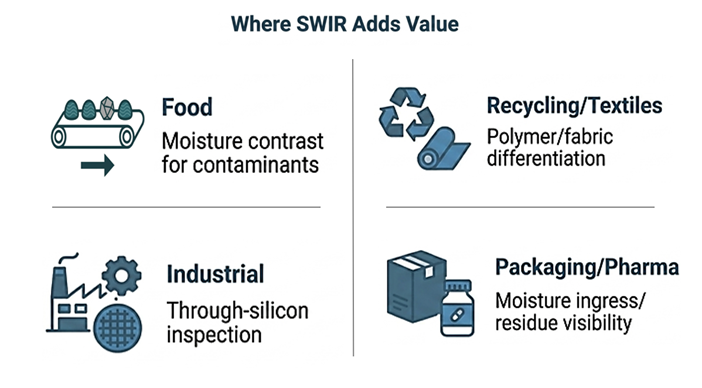
Figure 3. Key domains where SWIR imaging adds measurable value in modern sorting and inspection systems.
SWIR can identify materials in ways conventional visible cameras cannot. It reveals subtle differences in plastics and polymers, that visible cameras miss, and standard near‑infrared systems cannot distinguish.
In waste sorting plants, SWIR line-scan cameras rapidly classify materials, enabling quick ejection of plastics, textiles, and e-waste components that are invisible to conventional NIR systems.
Industrial sorting imaging goes further: silicon’s transparency above ~1100 nm enables non‑destructive SWIR inspection of solder joints and die structures through wafers, while SWIR inspection in pharmaceutical lines detects fill‑level variations and tablet cracks behind blister foil.
SWIR imaging also enables reliable fluid detection, leveraging strong absorption characteristics of water in the SWIR spectral range. This enables detection of water contamination in oils, lubricants, and manufactured parts like white goods where conventional imaging cannot easily distinguish fluids from other materials.
In packaging integrity and pharmaceutical inspection, SWIR reveals the presence of organic materials and residual humidity that remain invisible in visible or standard NIR imaging. This enables verification of package dryness, detection of moisture ingress, and identification of organic residues in sealed or opaque packaging, aiding quality control, and shelf-life assurance.
Exosens Lynx and Manx Series: SWIR Cameras for Sorting Applications
The Exosens Lynx series are compact, uncooled InGaAs SWIR line-scan cameras for high-speed sorting. The Lynx SQ is ideal for spatial sorting (e.g., foreign object and moisture detection), while the Lynx R excels in spectroscopic and hyperspectral applications. Both offer up to 2048-pixel resolution and integrate easily via CameraLink or GigE Vision.
Specification | Lynx SQ Series | Lynx R Series |
Spectral range | 900–1700 nm | 900–1700 nm |
Max line rate | 10 kHz (2048 px) / 40 kHz (1024 px) | 10 kHz (2048 px) / 40 kHz (1024 px) |
Pixel format | 512, 1024 or 2048 / 12.5 or 25 μm square | 1024 or 2048 / 12.5 μm rectangular with 250 μm pixel height |
Integration type | Snapshot — global shutter | Snapshot — global shutter |
Interface | CameraLink Base or GigE Vision | CameraLink Base or GigE Vision |
Optical interface | C-mount or M42 | C-mount or M42 |
Weight | 153 g (CL) / 208 g (GigE) | 153 g (CL) / 208 g (GigE) |
Power | 3.9 W (CL)/ 6.3 W (GigE) — DC 12 V | 3.9 W (CL)/ 6.3 W (GigE) — DC 12 V |
Table 1. Features of Lynx series
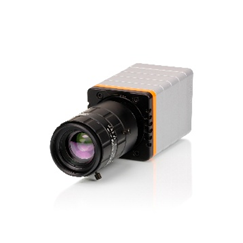
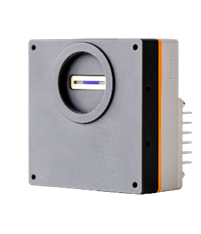
In addition, Exosens also offers Manx series, world’s fastest SWIR InGaAs line-scan camera. Both the Manx R and Manx SQ versions are suitable for demanding and high-speed sorting and spectroscopy applications. The Manx series offers superior performance in terms of noise, dynamic range and line rate. With its CoaXPress interfacing, the Manx series offers reliable streaming of data.
Specification | Manx SQ Series | Manx R Series |
Spectral range | 900–1700 nm | 900–1700 nm |
Max line rate | 128 or 256 kHz | 128 or 256 kHz |
Pixel format | 512, 1024 or 2048 / 12.5 μm square | 512, 1024 or 2048 / 12.5 μm rectangular |
Integration type | Snapshot — global shutter | Snapshot — global shutter |
Interface | CoaXPress | CoaXPress |
Optical interface | C-mount or M42 [M42 to F-mount adapter optional] | C-mount or M42 [M42 to F-mount adapter optional] |
Weight | 900 g | 900 g |
Power | up to 11 W (without TEC) — DC 24 V | up to 11 W (without TEC) — DC 24 V |
Table 2. Features of Manx series
Seeing What Matters Across Every Sorting Application
SWIR imaging represents a significant advancement, offering a fundamentally distinct data source that facilitates sorting decisions which once required manual intervention. Its adoption is supported by the following factors:
- Defect detection confidence: Sub-surface penetration and moisture contrast catch defects that surface cameras miss, reducing returns and recall risk.
- Quality grading precision: Hyperspectral chemical fingerprinting delivers quantitative, objective grading, replacing inconsistent human inspection, and supporting premium product positioning.
- Rapid material identification: Polymer-specific differentiation at conveyor speeds ensures recycling purity standards while maintaining optimal throughput.
- Scalable integration: Lynx and Manx cameras with versatile interfaces fit directly into existing machine vision architectures, minimizing deployment cost and time.
With stricter food safety standards, increasing recycling requirements, and higher quality expectations, the focus has shifted from whether to implement SWIR to how rapidly it can be put into use.
Related content

Jun 12th 2026
Wavefront Measurement in Deep-UV Optics
How Should Wavefront Be Measured in Deep-UV Optical Systems?


Naples.


Jun 08th 2026
Seeing Beyond the Visible Battlefield
Imaging Solutions for Decisive Defense Advantage

Jun 04th 2026
When Plasma Density Is the Experiment:
How Quantitative Wavefront Diagnostics Are Changing High-Field LWFA Research

May 26th 2026
Europe’s Infrared Defense Sovereignty
Exosens contributes to Europe’s stratégic defense sovereignty in infrared sensing through SPIRIT initiative

May 25th 2026
Exosens aboard ESA’s SMILE Mission
Exosens Enables Breakthrough X-Ray Imaging onboard ESA/CAS SMILE Mission

Paris.

FROM Jun 02nd 2026 TO Jun 05th 2026
Société Française de Thermique 2026
Join Exosens at the 34th Annual Congress of the Société Française de Thermique 2026

May 20th 2026
Exosens Doubles Cooled IR Camera Production
Exosens Doubles Production Capacity for Cooled Infrared Cameras to Meet Accelerating Demand in Long-Range Counter-drone systems